
Gallstones
I really can’t imagine how I ended up with gallstones - I barely eat any fat…
That was roughly the remark I recently heard from someone in connection with a high-fat diet. (Anyone who isn’t entirely new here will know that on butterbei.de, high-fat, low-carb eating is the name of the game.) That person subsequently had their gallbladder removed.
What is bile? What is a gallstone?
The liver produces bile fluid (“bile”) - its purpose is to put the body in a position to absorb fat from food.
Unless it is used straight away, this fluid is stored in the gallbladder and, the longer it lingers there, concentrated as well: the liver produces bile more or less constantly, and it is the gallbladder that sees to the appropriate dosing into the digestive tract - depending on the amount of fat consumed.
If someone eats little fat, correspondingly little fluid is released, and the rest is concentrated further (in order to take up more from the liver).
When this concentration becomes too strong, the components can crystallise out - and the word “crystal” already comes very close to the expected result: gallstones are the crystallised-out components of bile fluid. (1)
Prevention
With this knowledge it is easy to explain the bafflement of the person quoted at the outset: the relationship is exactly the other way around:
Because the person took in so little fat, the gallbladder had no choice but to concentrate the unused bile more and more, until it crystallised.
Use it or lose it
That gives a completely different picture for a new mental model: to prevent gallstones, you simply have to eat enough (usually: more) fat.
Oh dear - even more calories?

As long as the bile is used, as long as it keeps moving, no crystals form either.
Acute Treatment
Does more fat also help as an acute treatment for existing gallstones?
Conventionally, a low-fat diet is recommended for gallstones. And in the acute phase that does make sense: the contraction of the gallbladder (to release bile) naturally causes problems when it is blocked by crystals.
But fundamentally: 🤷. This is not a matter for a blog article from the internet, this is a case for medical treatment. All you’ll get here is the explanation of why the medical profession advises what it advises.
High-fat eating without a gallbladder
Is it still possible to eat high-fat or ketogenic even after the gallbladder has been removed?
A disclaimer first: the following paragraph rests on other people’s experiences
- I myself - having a gallbladder - cannot report on this from my own experience:
Yes, it is possible - after all, the liver continues to produce bile. As a rule, only the gallbladder is removed, and with it the storage and dosing aid. It can be advantageous to spread high-fat meals out more across the day, that is, to eat several smaller meals a day because of the missing gallbladder. This stands in contrast to the classic dietary advice, which likewise recommends many small meals at a high carbohydrate share, but for a completely different reason: to avoid blood-sugar spikes and crashes. With a high-fat, low-carbohydrate diet that is simply not necessary - because this way of eating causes no blood-sugar spikes that would need to be reduced.
Low on Fat - Rolling in Stones?(2)
Exactly. A low-fat diet potentially leaves you rolling in (gall)stones. It is almost as if the usual dietary guidelines, out of an inexplicable fear (3) of fat, ignore this connection entirely and therefore wilfully keep stoking the population’s fear of fats.
I, for one, absolutely cannot relate to this fear.
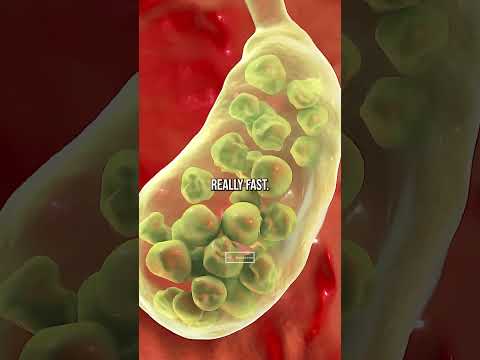
(Alternatively, you could also watch a very short illustrated version with an explanation. Brief summary: If you use up all your bile, you’ll not have to worry about it forming a stone, ever)