
Allan Savory: What Holds Up, What Doesn't
In a footnote of the article Pasture-Raised Ruminants I mentioned a point of disagreement, in connection with Allan Savory’s talk “How to fight desertification and reverse climate change"(1).
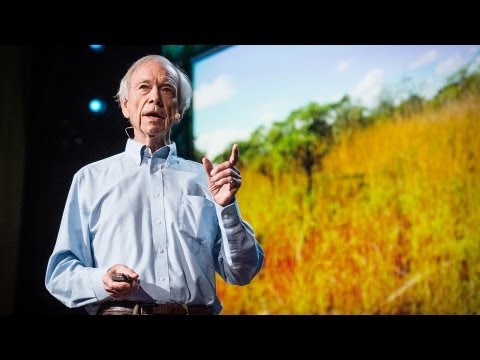
Here on TED, and embedded from YouTube:
Today it’s time to come back to it - and surprise: there aren’t one but two different arguments to address:
A Claim in the Talk
Shortly before the end of the talk, Savory notes that the carbon which could be sequestered in half of the world’s grassland under good grazing management would be enough to bring us back to pre-industrial levels. The recording is from 2013, and I don’t know how old his insight was at the time, but by today’s understanding that order of magnitude doesn’t hold up.
Elsewhere I’ve already cited “Secure Soil, Save Life"(2), a 2025 report. On page 15 it states:
A Save Soil analysis estimates that improving soil condition could absorb up to 27% of the carbon needed to keep warming under 2 °C.
Unfortunately the timeframe needed for that is not mentioned - but we can see that the contribution soil can make is already far from negligible.
The passage following this sentence is also worth reading:
Soil with high organic matter effectively locks carbon away for long periods and improves soil structure to protect carbon from decomposition, supporting a diverse microbial community that converts plant residues into stable organic matter, and enhancing water retention. Furthermore, transitioning to regenerative agriculture, which minimises soil disturbance and synthetic inputs, not only unlocks this sequestration power but also actively reduces emissions in two ways: directly, by decreasing CO2release from the soil (e.g. by reduced or no tillage); and indirectly, by lowering the substantial emissions associated with the production and transport of synthetic fertilisers due to decreased dependence on chemical inputs. Therefore, recognising soil’s potential is a crucial, practical strategy to move the world toward nutrient balanced, net-zero emissions and a nature-positive agricultural system (Conscious Planet, 2024a (3) ).
So soil can and must make an important contribution to carbon sequestration - but the order of magnitude expressed in the talk doesn’t check out.
A Second Objection
And anyone who clicked the TED link will have noticed that TED flags an entirely different conflict there. It states that methane from the animals cancels out any carbon sequestration in the soil (though the linked article is no longer available - it’s unclear whether it was retracted or the link is simply dead).
Since it’s unclear exactly what the argument is, and whether it still stands:
We need to get used to the fact that natural processes also introduce natural substances into the environment. Methane from ruminants comes from carbon that is already in the biological cycle. Since it breaks down again within 10 years, the total amount in the atmosphere stays constant when animal numbers remain stable: as much is regularly produced as is broken down.
If we double the number of animals, their methane output doubles once - and that’s where it stops - and with it the biological methane in the atmosphere.
And that’s the asymmetry the methane argument tends to skip: the methane adjusts once, then flatlines at the new level. The carbon building up in the soil under good grazing management, however, keeps accumulating - year on year, for as long as the land is well managed. A one-time step change on one side, a compounding benefit on the other. The longer the time horizon, the weaker the “too much methane” objection gets.
If, on the other hand, we halve the number of animals, not only does the methane halve over time, but biodiversity decreases too. Not because of the highly bred animals we may no longer keep, but through the organisms living in symbiosis with them. Animals are the environment!
Humans, by contrast, are massively introducing “fresh” carbon from fossil sources into the atmosphere. This carbon - whether as methane or CO2 - wasn’t there before. In case anyone didn’t know: methane is the main component of natural gas.
Ruminant methane is biological, not fossil. Termites also produce enormous amounts of it - nobody is calling for their abolition. When natural processes in the cycle suddenly become a problem, that is a symptom triggered by the excessive presence of fossil carbon, not by the biological system.
That is in the control of humans (who got us into this situation), not the animals.
But for anyone who finds this too apocalyptic: we simply need the services of ruminants in building soil. And work has long been under way in agriculture to reduce methane emissions from cattle - among other things via feed additives, and a switch from barn to pasture husbandry would also contribute a great deal(4).
If we want to feed the people living now and in the future, we’ve seen that it can’t be done without soil. And we’ve seen that this soil needs help: it can’t be done without grazing(2).


